If you manage an office, you’ve probably heard plenty about the Americans with Disabilities Act (ADA). But what does it actually expect from you on a day-to-day basis?
In practical terms, the ADA expects you to help create a workplace that people with disabilities can access, work in, and participate in fairly. That includes physical access, hiring practices, workplace policies, technology, communication, and accommodations.
This is not just an HR issue or a facilities issue. Office managers are often the people making sure the workplace actually functions in a way that complies with the law.
Here’s what that means in real life.
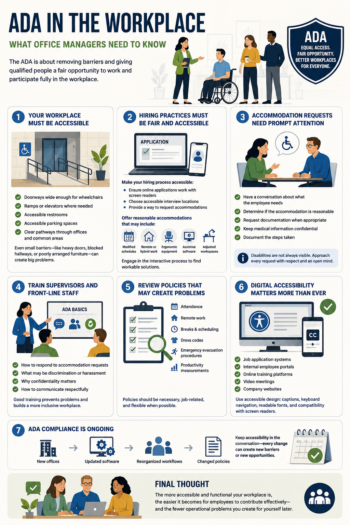
1. Your Workplace Must Be Accessible
Accessibility starts with the physical environment. Employees, clients, applicants, vendors, and visitors all need to be able to access your workplace.
That can include:
- Doorways wide enough for wheelchairs
- Ramps or elevators where needed
- Accessible restrooms
- Accessible parking spaces
- Clear pathways through offices and common areas
Even if you lease space in a larger building, you may share responsibility with the property owner for accessibility issues affecting your part of the workplace.
Accessibility also includes practical details people sometimes overlook. Heavy doors, blocked hallways, inaccessible break rooms, and poorly arranged furniture can all create barriers.
2. Hiring Practices Must Be Fair and Accessible
The ADA prohibits discrimination against qualified individuals with disabilities in hiring, promotion, compensation, and other employment decisions.
That means your hiring process should be accessible from beginning to end.
Think about:
- Whether online applications work properly with screen readers
- Whether interview locations are accessible
- Whether candidates have a way to request accommodations during the hiring process
You are also expected to consider reasonable accommodations that would allow someone to perform the essential functions of the job.
Reasonable accommodations can include:
- Modified schedules
- Remote or hybrid work arrangements
- Ergonomic equipment
- Assistive software
- Adjusted workspace setups
You are not required to create an undue hardship for the business, but you are expected to engage in the interactive process—a good-faith effort to explore workable solutions.
3. Accommodation Requests Need Prompt Attention
When an employee requests an accommodation, how you respond matters.
You do not need to become a medical expert, but you do need to take the request seriously and respond appropriately.
That generally means:
- Having a conversation about what the employee needs
- Determining whether the accommodation is reasonable
- Requesting documentation when appropriate
- Keeping medical information confidential
- Documenting the steps taken
Disabilities are not always visible. Employees may request accommodations related to chronic illness, mental health conditions, ADHD, autism spectrum disorder, sensory sensitivities, or other conditions that are not immediately obvious.
Even if you cannot provide the exact accommodation requested, you are expected to explore effective alternatives.
4. Train Supervisors and Front-Line Staff
Many ADA problems start with poor communication, bad assumptions, or inconsistent handling of requests.
Basic training can help prevent that.
Supervisors and managers should understand:
- How to respond when someone requests an accommodation
- What kinds of comments or behavior may cross the line into discrimination or harassment
- Why confidentiality matters
- How to communicate respectfully with employees and visitors with disabilities
Front-desk and customer-facing staff should also understand accessibility basics, especially if they regularly interact with the public.
5. Review Policies That May Create Problems
Some workplace policies unintentionally create barriers for employees with disabilities.
Review policies involving:
- Attendance
- Remote work
- Breaks and scheduling
- Dress codes
- Emergency evacuation procedures
- Productivity measurements
Ask yourself whether the policy is truly necessary as written—or whether some flexibility is possible without disrupting operations.
Office managers are often the people who spot these operational problems first.
6. Digital Accessibility Matters More Than Ever
Accessibility now extends well beyond the physical office.
If your workplace relies on digital systems, those systems should also be accessible.
That can include:
- Job application systems
- Internal employee portals
- Online training platforms
- Video meetings
- Company websites
Increasingly, courts and regulators are treating digital accessibility as part of ADA compliance, especially for public-facing websites and employee systems.
Features such as captioned videos, keyboard navigation, readable fonts, and compatibility with screen readers are becoming standard expectations.
7. ADA Compliance Is Ongoing
The ADA is not something you “finish.”
Every time your organization changes offices, updates software, reorganizes workflows, or changes policies, accessibility should remain part of the conversation.
That does not mean every situation will be simple. It means accessibility needs to be considered as part of normal workplace management.
Final Thought
The ADA ultimately asks employers to remove unnecessary barriers and give qualified people a fair opportunity to work and participate fully in the workplace.
For office managers, that comes down to something fairly straightforward: running an office that works for people.
The more accessible and functional your workplace is, the easier it becomes for employees to contribute effectively—and the fewer operational problems you create for yourself later.